
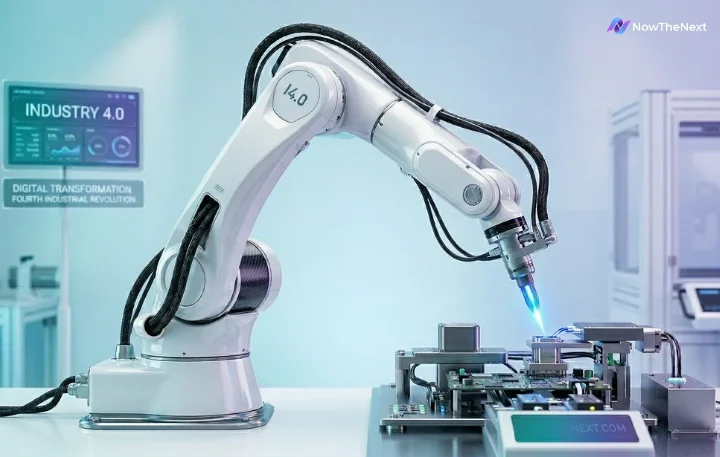
The fourth industrial revolution is changing manufacturing in ways in which it cannot be overestimated.. Artificial intelligence, connected machines, digital replicas of factories, and autonomous robots are not future possibilities; they are present realities. We shall now examine what Industry 4.0 actually is, where it is being applied, what stands in its way, and what firms and governments must do to keep up.
The Old Way of Making Things Has Run Out of Road
For two centuries, manufacturing ran on a simple logic. Standardise processes. Use cheap labour. Produce at scale. The model worked. Clearly we do not see it working now.
Global supply chains shut drastically in 2020. COVID 19 shutdowns exposed how fragile the system had become. According to Alix Partners, the automotive industry alone lost $210 billion in output in 2021 because of semiconductor shortages. Factories built for efficiency had no room to adapt when conditions changed overnight at such a scale.
Labour costs have also risen sharply in historically low wage countries. China’s average manufacturing wage grew 8.5% per year between 2010 and 2022, per the National Bureau of Statistics of China. The cost advantage that shaped global supply chains over decades is shrinking, in country considered the global hub of manufacturing.
“The era of cheap labour as the primary competitive lever in manufacturing is over. The next advantage is intelligence.”
Majority of the manufacturers are aware of the issue but have not addressed it. This difference between companies who have really assumed these technologies and companies who are experimenting is growing year after year. A report conducted by Accenture in 2022 under Industry X discovered that full adopters would have positively higher profit margins by 6.7 percentage points compared to traditional ones. The time of lagging behind is reducing year by year by a few months.
Industry 4.0 Efficiency Benchmarks
Comparative Analysis based on Accenture Industry X Report
(% revenue)
(5-yr CAGR %)
(5-yr CAGR %)
(%)
Three Revolutions Built the Factory. The Fourth Is Rebuilding It
The term “Industry 4.0” was given by the German government in 2011. Professor Klaus Schwab of the World Economic Forum brought it to global attention in 2016. The numbering is deliberate. It marks the fourth distinct transformation of industrial production since the eighteenth century.
4.0
Machines are keeping a watch and adapting by themselves
The Internet of Things Gives Every Machine a Voice
In an old school factory, machines just churn out products. In a smart one, they also chat back. Sensors tucked into the gear track stuff like heat, shakes, pressure, output speed, and power use all the time, right as it happens.
Bosch has wired up over 230 factories with IoT sensors. Their smart algorithms spot machine glitches about ten days before they turn into breakdowns. Unplanned shutdowns dropped 25% across the board, according to Bosch’s 2022 Annual Report. The factory doesn’t sit around waiting for trouble anymore, it jumps in early.
Digital Twins Engineers can conduct experiments free from hassle Mistakes in reality
Simply put, digital twins are software versions of the physical objects, processes, and systems you own. Test new setups or simulated shortages in raw material or gear failures all without spending any real money or using actual parts.
Siemens has its technologically advanced plant in Amberg, Germany. It manufactures programmable logic controllers. All tasks are performed using digital twins, achieving an insane quality rate of 99.9988% in 2022. The facility has produced ten times more products since 1989 while making far fewer errors and occupying the same physical space. According to Siemens, people have carried out 4% of their jobs.
AI replaces quality control with proactive problem prevention
The classic method for ensuring that products meet quality standards? You check a few of them and feel confident. Industry 4.0 features AI for examining each component produced on the conveyor belt. In 2021, Foxconn incorporated AI vision equipment in one of its manufacturing facilities in Zhengzhou. Every iPhone element is photographed by the computer cameras at 60 frames per second. They detect faults with accuracy levels of 99.99%, whereas humans achieve an 85% success rate, according to MIT Technology Review (2022).
The Global Supply Chain Is Too Slow and Too Blind for What the World Now Demands
The pandemic did not cause supply chain vulnerabilities to arise. It merely exposed them. Years of cost reduction measures – lean inventories, single-source suppliers, and low-cost locations – had left the system devoid of any cushion. In times of change, there was nothing to absorb the impact.
According to Harvard Business Review (2020), the average large business had 200 direct suppliers. However, these suppliers together sourced components from more than 5,000 secondary and tertiary suppliers. Most businesses were unaware of this extensive supply chain. An interruption at one Taiwanese chipmaker triggered consequences at auto manufacturers in Germany and consumer electronics manufacturers in South Korea before the purchasing department even knew its origin.
“Supply chain leaders who invested in digital visibility before the pandemic recovered 2.5x faster than those who had not.”
The solution lies not in shrinking the length of the supply chain but rather in making it transparent and flexible. By implementing IoT technology, blockchain-based traceability, and AI-based demand sensing, the supply chain becomes an intelligent system that can react instantly. IBM and Walmart successfully implemented Food Trust Blockchain to change the rules of the game in food traceability. Before that innovation, Walmart took about seven days to find out the source of the contaminated mangoes, but now it takes merely 2.2 seconds to identify it. This case, presented by IBM and Walmart (2019), became the industry’s best practice for food traceability as well as pharmaceuticals.
Because of deep learning algorithms with more than 400 variables in the inputs, Amazon can predict the demand on the regional level, thus providing enough stocks at the proper fulfillment center prior to the customer’s order. Amazon reduced logistics expenses as a share of revenue from 14.2 percent in 2016 to 9.8 percent in 2022 based on SEC reports.
Adoption Is Growing — But Most Firms Are Not Even In The Game
IoT sensors and cloud computing are already widely adopted. More than 67% and 72% of companies have scaled this out in their operations, according to McKinsey (2023). However, the real game changers digital twins, autonomous robots, augmented reality continue to be tested in pilots for now.
The Global Lighthouse Network by the World Economic Forum catalogues factories at the cutting edge of Industry 4.0 adoption. As of 2023, there are 153 such plants in 24 countries. They are actual production lines, not experimental projects. They show that it can be done on a large scale.
According to KPMG’s Industry 4.0 Maturity Index for 2022, here are the main distinctions between Lighthouses and other factories: integrated data platform vs. isolated applications; management with technological and operational expertise; an actionable employee skill upgrade plan; and scalability methodology that begins with one production line and then expands methodically.
Industry 4.0 Technology Adoption (2023)
Source: McKinsey Global Manufacturing Survey
Industry 4.0 Readiness Index by Country (2023)
India’s score of 49 reflects a specific structural problem. India has the world’s second largest pool of STEM graduates and genuine strength in software. But its manufacturing sector is dominated by small and medium enterprises with limited capital for technology investment. KPMG India (2023) estimates that 78% of Indian manufacturers remain at Industry 1.0 or 2.0 maturity. The firms that most need digital transformation are often the least equipped to fund it. Seems like the STEM education is not the skill necessary for growth where the other sectors are booming.
Automation Creates Jobs — But Not for the People Whose Jobs It Eliminates- The Unskilled Frontline
The World Economic Forum’s Future of Jobs Report 2023 projects that automation will displace 85 million jobs by 2025. It also projects that 97 million new roles will emerge. The net figure is positive. The transition is not straightforward.
The jobs created by Industry 4.0 require skills that displaced manufacturing workers do not currently have. A machine operator whose role is taken by a collaborative robot cannot immediately programme or maintain that robot.
“The question is not whether automation creates jobs. It does. The question is whether the people displaced can access those jobs. Often, they cannot.”
Geography compounds the problem. New jobs cluster in urban, technology intensive areas. Displaced manufacturing jobs are concentrated in industrial towns with limited economic alternatives. In the United States, the Brookings Institution (2019) found that 90% of new technology sector employment since 2010 was created in just five metropolitan areas. Survival of the fittest here is for the people at the top mostly.
The dual education system in Germany is an ideal example of integrating vocational and academic education in order to make labor adjust itself to technical changes in society. During lockdown periods due to the coronavirus outbreak, “kurzarbeit” program helped about two-and-a-half million workers retain their jobs.
Automation: Jobs Displaced vs. New Jobs Created (2020-2025)
THE COMMON THREAD BETWEEN GOVERNMENTS AND FIRMS GETTING THIS RIGHT
Building Data Foundation First
Those organizations that are not caught in pilot purgatory all share one thing. To them, data serves as an infrastructure rather than an end product. In the McKinsey 2023 Manufacturing Report, the data layer is revealed to be the greatest value-creation lever in the entire Industry 4.0 stack.
Between 2018 and 2021, Schneider Electric revamped its manufacturing data system, creating a layer of data integration between 200 plants, 500,000 assets, and external supply chain organizations. Schneider Electric’s sustainability report from 2022 indicates a 30% decrease in energy consumption and a 50% increase in on-time deliveries.
Design Work Around Human and Machine Strengths Together
Industry 4.0 is not about replacing workers with machines. Rather, it is about designing a system where the benefits of both machines and humans are exploited in their own areas.
At the BMW plant in Spartanburg, South Carolina, there are 1,400 cobots working alongside human assemblers. While the cobots execute activities that require high precision, repetition, and strength, humans are involved in making contextual decisions and performing detailed quality control. There have been reports of a 30% increase in assembly productivity and a 60% reduction in ergonomic injuries at BMW since cobots were adopted (BMW Group, 2022).
Accenture found that firms gaining the highest returns from AI had redesigned their workflow systems to ensure human-machine collaboration rather than automating their operations.
Public Investment in Workforce Adaptation Is Not Optional
It is impossible for any business to address the workforce transition issue by itself without government intervention.
The SkillsFuture scheme in Singapore receives S$500 million each year for the re-skilling of adults, including special schemes for jobs within Industry 4.0. Even after the adoption of automation technology, manufacturing jobs account for over 14% of GDP (Singapore MTI, 2023).
In South Korea, the Manufacturing Innovation 3.0 project supported over 35,000 projects involving the digitalisation of factories from 2014 to 2022, particularly in small- and medium-sized enterprises. The productivity levels increased by 32% on average during the period.
NETWORK GLOBALISATION – ACCESSABILITY
As production factories evolve into more advanced factories, they also face more exposure to being breached. Hence, every sensor, the cloud, and any point of communication serve as a possible source of risk. The more intelligent a factory is, the more significant costs there will be if it is not properly secured. The Colonial Pipeline Company Ransomware Attack in 2021 resulted in the complete shutdown of the Eastern Seaboard fuel delivery system to the US. As identified by Accenture in its report on Cybersecurity Resilience in 2022, there was an increase of three times the number of attack incidents on industrial organisations from 2019 to 2022. When new technologies are implemented, cybersecurity must be considered a priority.
Data sovereignty is another concept within the realm of cybersecurity. The European Union’s 2023 Data Act, the Government of China's 2021 Data Security Law, and the Indian Government's Digital Personal Data Protection Act in 2023 have each established different definitions and regulation regarding the who, what, where and how of data related to factories. Each of these legislative enactments creates true barriers to international business.
How Does Industrial IoT Impact Manufacturing Cybersecurity and Data Risks?
Industrial IoT transforms factories into data-driven ecosystems, but every sensor and cloud connection increases the attack surface. As “smart” connectivity grows, so does the risk of breaches, like the Colonial Pipeline attack. Consequently, cybersecurity and navigating global data sovereignty laws are now critical priorities to prevent catastrophic industrial shutdowns.
“Every connected device in an industrial environment is both an asset and a liability. Manufacturers who treat cybersecurity as optional are building on unstable ground.”
THE FIRST MOVER ADVANTAGE
Why Waiting to Adopt Industry 4.0 is a Strategic Risk
It is the companies that move now that will set the terms. The others will have to follow. Industry 4.0 is not merely an evolving technology wave that businesses can choose to follow whenever they are ready. It represents a fundamental rethinking of how manufacturing works, how supply chains behave, and how competitive advantage is established. The facts are unequivocal regardless of sector, country, or business size.
Identifying the Barriers: Pilot Purgatory and Security Gaps
The challenge exists. Companies find themselves stuck in pilot purgatory. Many countries are woefully unprepared. The workforce shift promises to be disruptive even before it brings benefits. The issue of cybersecurity governance cannot keep up with adoption rates.
The Roadmap for Success: Data Integration and Workforce Strategy
The solution is concrete and tangible. Companies that build up data integration infrastructures, adopt work methods for human-machine teamwork, and develop their workforce beat their counterparts that fail to act in these areas. Countries that use a combined approach involving industrial strategy and educational reforms keep their manufacturing employment base while increasing productivity.
Technology and capital investments are only secondary variables in the equation. The primary variable is whether or not you have chosen to go all in.
The factories that will dominate in 2035 are being designed today.
NowTheNext Glossary
Industry 4.0
The Fourth Industrial Revolution characterized by the fusion of physical assets and advanced digital technologies like AI and IoT.
Digital Twin
A real-time, software-based virtual replica of a physical object or system used for simulation and testing without physical risk.
IoT (Internet of Things)
A network of sensors and software embedded in machinery to collect and exchange data for real-time monitoring.
Predictive Maintenance
Using AI and IoT data to identify potential machine failures before they occur, reducing unplanned downtime.
Cobots (Collaborative Robots)
Robots designed to work safely alongside humans, combining machine precision with human contextual decision-making.
Pilot Purgatory
A state where companies test Industry 4.0 technologies in small trials but fail to scale them across the entire organization.
Data Sovereignty
The legal and ethical concept that data is subject to the laws and governance of the country where it is collected.
STEM (Science, Technology, Engineering, Math)
The core academic disciplines that drive innovation and shape the workforce behind smart manufacturing.
Supply Chain Visibility
The ability to track every component and product in real time across all tiers of a global supply network.
Blockchain Traceability
Using a decentralized ledger to record a product’s journey, helping ensure transparency in areas such as food, pharma, and industrial sourcing.
FAQs
The primary barrier is “Pilot Purgatory” and high capital costs. As seen in India, where 78% of manufacturers remain at Industry 1.0 or 2.0, SMEs often have the STEM talent but lack the integrated data platforms and scalability methodology needed to fund and expand digital transformation beyond a single production line.
While automation may displace repetitive roles, it creates a net positive growth (projecting 97 million new roles vs. 85 million displaced). The challenge is that these new roles require programming and maintenance skills that unskilled workers lack, necessitating public investment in re-skilling schemes like Singapore’s SkillsFuture.
Yes. For example, Siemens’ plant in Germany uses digital twins for all tasks, achieving a 99.9988% quality rate. This allows factories to produce significantly more (up to 10x higher output) within the same physical footprint by simulating setups and identifying errors before they happen in reality.
Beyond productivity, the “Data Layer” is a massive lever for sustainability. Real-time monitoring allows for significant energy optimization; for instance, Schneider Electric reduced energy consumption by 30% through integrated data systems across their plants.
In a smart factory, every connected sensor is a potential entry point for risks like ransomware. As industrial organizations become more intelligent and connected, the cost of a breach—such as the Colonial Pipeline shutdown—makes cybersecurity a non-negotiable priority for stable operations.
References
Selected reports, annual reports, and research sources used for this article.
- McKinsey Global Institute (2023). Global Manufacturing Survey. McKinsey & Company.
- McKinsey Global Institute (2022). The Future of Work After COVID 19. McKinsey & Company.
- McKinsey & Company (2021). Supply Chain Resilience. McKinsey & Company.
- Accenture (2022). Industry X: Reinventing Manufacturing and Supply Chains.
- Accenture (2022). State of Cybersecurity Resilience 2022. Accenture Security.
- KPMG International (2022). Industry 4.0 Maturity Index. KPMG International.
- KPMG India (2023). Manufacturing in the Digital Age. KPMG India Advisory.
- World Economic Forum (2023). Future of Jobs Report 2023. WEF, Geneva.
- World Economic Forum (2023). Global Lighthouse Network Annual Report. WEF.
- Harvard Business Review (2021). The Automation Paradox. Harvard Publishing.
- Harvard Business Review (2020). Supply Chain Blind Spots. Harvard Publishing.
- Schwab, K. (2016). The Fourth Industrial Revolution. World Economic Forum.
- BCG (2022). Nine Pillars of Industry 4.0. Boston Consulting Group.
- Siemens AG (2022). Annual Report 2022. Siemens AG, Munich.
- BMW Group (2022). Annual Report 2022. BMW Group, Munich.
- Bosch GmbH (2022). Annual Report 2022. Robert Bosch GmbH.
- Singapore Ministry of Trade and Industry (2023). SkillsFuture Programme Review.
- Deloitte / WEF (2023). Industry 4.0 Readiness Assessment. Deloitte Insights.
- Alix Partners (2022). Global Automotive Outlook.
- MIT Technology Review (2022). AI Visual Inspection in Electronics Manufacturing.
- IBM / Walmart (2019). IBM Food Trust: Walmart Case Study.
- Brookings Institution (2019). The Geography of New Technology Employment in the US.

Steven Reynolds
The distinction between an integrated data platform and isolated applications helps explain why a successful pilot may never become a factory-wide capability. For the Indian SMEs described here as having limited investment capital, a cheap pilot could become an expensive dead end if its data cannot move beyond one machine or vendor. I would want interoperability and the cost of extending to a second production line included in the pilot’s success criteria, not just its initial productivity gain.