
Imagine a scene which could have unfolded countless times at workplaces around the globe somewhere around late 2022. A mid-level analyst working at a financial services company, with ten years of experience under his belt, and two degrees who was really quite skilled at what he was doing witnessed how a chat bot completed a task in a span of forty seconds that formed the core of his week’s assignment. He didn’t lose his job on that very day. But he left the office that evening and Googled “will AI take my job”. And he was not alone in this feeling.
The fear of being replaced by an algorithm is something very real that should neither be ignored nor sensationalized. What it definitely doesn’t deserve is all the hype and misinformation which has become common following the public release of large language models. “AI will replace 300 million jobs by 2035.” “Almost 50% of all entry-level jobs will vanish by 2030.” “Your job is doomed.” These statements may appear to be exaggerated but there is truth to them the statements are taken straight out of real economic research, just without the rest.
AI and jobs facts on the ground aren’t as clean, clear, and certainly less dire than you might think from watching the headlines. Getting to grips with the issue means distinguishing three different processes that tend to become hopelessly tangled together.
I. AI Job Displacement Statistics: What the Data Actually Shows
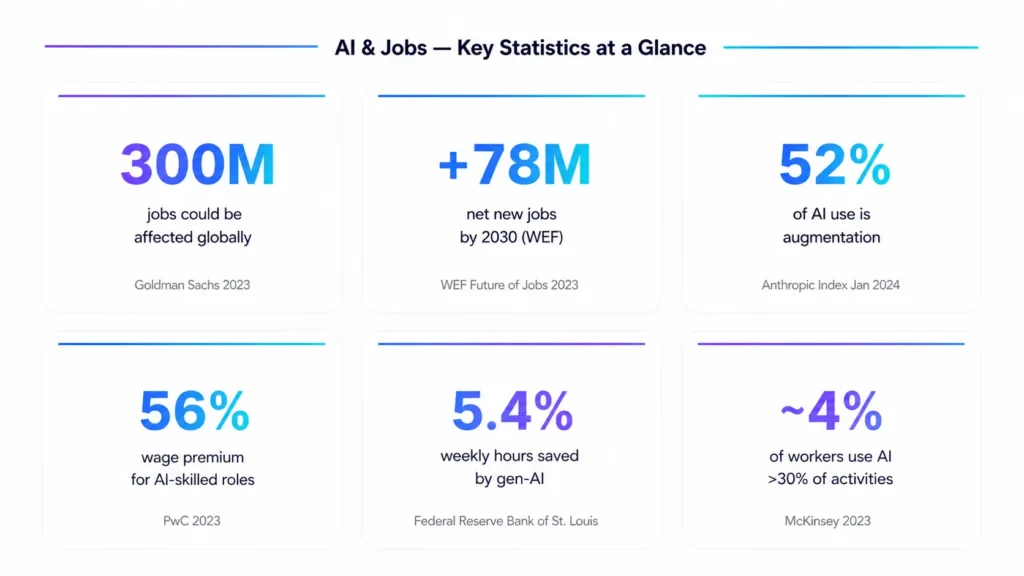
Let us start with the number that caused the concern: Goldman Sachs said that artificial intelligence that can create things could do work that is equal to 300 million full time jobs around the world. This number has been used in every third article about this topic since 2023. People usually do not mention the important part that comes after it in the original research. This part says that two thirds of jobs will have some parts that can be automated but they will not be completely eliminated. We know from the past that new technologies have actually created more jobs in the end.
The World Economic Forum made a report about the future of jobs in 2025. They asked over 1,000 employers who have 14 million workers in 55 countries about intelligence and jobs. This report gives us the idea of what will happen to jobs because of artificial intelligence:
- 92 million jobs will be replaced by 2030
- 170 million new jobs will be created in the same time
- We will have about 78 million jobs, which is the biggest increase in jobs in modern times
- 41% of employers plan to have fewer workers in areas where artificial intelligence can do the work but 77% of these employers also plan to help their workers learn new skills until 2030
The International Monetary Fund also looked at how artificial intelligence will affect jobs in different parts of the world. They found that 40% of jobs around the world will be affected by artificial intelligence. This number is even higher, 60% in countries that’re already very advanced and use a lot of technology. At first this sounds like it will be a problem. But then we read that in countries where people earn a lot of money artificial intelligence is just as likely to help workers earn more because they are more productive as it is to replace them. Artificial intelligence will have an impact, on jobs and we need to think about what artificial intelligence will mean for workers and employers.
Is the Media Exaggerating the Speed of Job Loss?
Short answer: yes, in most cases. The displacement is real, but the timeline is consistently misread. McKinsey’s technology capability research suggests that while today’s AI could theoretically automate 57% of current tasks, actual enterprise adoption remains constrained by integration complexity, regulatory friction, change management failures, and the stubborn reality that most business processes were not designed with AI augmentation in mind.
Gartner predicts AI’s net impact on global jobs will remain broadly neutral through 2026. The wave is coming, but it isn’t arriving all at once. PwC’s 2025 AI Jobs Barometer found that between 2019 and 2024, even occupations with high AI exposure still posted 38% job growth lower than the 65% seen in low-exposure roles, but hardly the extinction event the headlines implied.
II. Displacement vs. Transformation: The Reconfiguration of Modern Labor
Here is where the conversation needs to get more precise, because conflating job loss with task automation produces genuinely misleading conclusions. McKinsey’s analysis from 2025 determined that 60% of all jobs can be automated by at least 30%. That is different than claiming there is a 60% risk any job will be lost. Many tasks in a job are worth being automated but not all are automated.
Many roles are facing direct pressure, especially those roles that might have significant portions that could be automated. These include basic graphic design, and legal services. According to experts, the absolute count of employment in customer service industry in U.S. shrank by approximately 80,000 from 2022 to 2024. AI-enabled automation played a meaningful role in this change. Far from being fictitious, these roles are genuine occupations carried out by actual individuals, warranting sincere recognition of the upheaval they face.
- Explosive Growth in Collaborative Roles: The job market is seeing a surge in positions that work alongside AI rather than competing with it.
- Significant Wage Premium: According to PwC, roles requiring AI skill sets now command a 56% pay premium, a massive jump from the 25% premium seen just a year ago.
- Strong Software Development Outlook: The U.S. Bureau of Labour Statistics projects software developer employment to grow by 17.9% through 2033.
- High Demand for Security: Information security analyst roles are expected to expand by 32% through 2032.
- Market Reorganization: The overall “demand signal” indicates the market isn’t shrinking; it is actively reorganizing around new technological capabilities.
This is the part of the conversation that rarely makes headlines, because it does not generate the same emotional response as job loss. But it matters enormously for understanding the actual impact of AI on employment.
Federal Reserve Bank of St. Louis research that generative AI now saves the average knowledge worker around 5.4% of their weekly hours – around 2.2 hours in a 40-hour week. Time is not disappearing. In most organizations, this is getting redirected into higher-order work: strategy, client relationships, creative problem-solving, mentoring, product development. These are exactly the kinds of activities that don’t have AI as a credible solution for at scale already.
According to a recent analysis from PwC, industries that are most in danger of AI automation generate, on average, three times the revenue per employee compared to least-exposed sectors. Between 2018 and 2024, productivity growth in those industries exposed to AI accelerated nearly fourfold. The economic case for automation is not simply to reduce headcount but do more with the same headcount. Unfortunately, the excess stress and fatigue hurt productivity levels and can lead to burn-out if left unchecked.
A recent Anthropic Economic Index from January 2026 has found that 52% of AI interactions presently are augmentation i.e. making existing workers quicker and more effective, instead of directly replacing their roles. That data point is worthy of much more attention.
Jobs at Risk vs Jobs Being Created
III. Agentic AI
The Real Inflection Point Worth Watching
If there is a legitimate reason for recalibrating urgency, it is here. AGI systems, which can perform multiple steps on their own (and don’t require constant human intervention) represent a qualitatively different challenge than the language models we see today. AI systems that generate content complete tasks when prompted. Workflows are implemented by Agentic AIs.
Deloitte estimates that one in four companies currently using generative AI will launch agentic AI pilots by 2025, with adoption reaching 50% by 2027. As discussed on the Now The Next’s Technology vs. Anxiety podcast series, the transition to agentic systems introduces a new set of workforce implications that go beyond task automation entire decision workflows, not just individual tasks, become candidates for delegation to AI systems. This is the shift that actually deserves serious workforce planning, not the chat bot demos that took over 2023 coverage.
Roles most resilient to agentic disruption share a consistent profile: situational judgment depending on tacit knowledge, accountability structures ill-suited for complete automation, emotional and relational intelligence or physical presence. A radiologist interpreting scans, a project manager negotiating organizational politics, a teacher adapting to a struggling student in real time, a plumber tracing a fault no one had anticipated these are all roles built on capabilities that current AI architectures fundamentally lack.
IV. The Productivity Paradox Nobody Is Talking About
There is a peculiar disconnect sitting at the centre of the AI employment debate. More than 91% of organizations use AI for at least one task. Productivity across the whole OECD was only 0.4% in 2024 even though AI usage per tool increased. This phenomenon has been defined by Gartner as the “AI productivity paradox,” which refers to the situation whereby companies using AI do not see the expected productivity benefits due to a failure to adapt the underlying workflows.
Another example of such discrepancy can be found in McKinsey’s 2025 leadership survey, where it turned out that only 4% of workers use AI for more than 30% of their activities while the real number should be 13%. Thus, the adoption of AI tools in business has already started to exceed what managers perceive it.
When considering AI-driven job loss, this fact should be taken into account as a key part of the process does not go through the official channel but is happening from below in an unstructured manner 78% of AI users bring personal software solutions to work.
AI Is an Assistant, Not an Trouble shooter
AI job displacement happens. It is happening right now, and it is not happening uniformly, nor only within one industry sector. But the concept of mass displacement the narrative of wholesale replacement where artificial intelligence is sweeping the labour force, taking everyone down with it is not backed up by the numbers. Rather, there is evidence of restructuring: a changing view on the nature of work, on what can be accomplished by people alone and what needs to be done together.
Workers at risk are not necessarily those who work using AI; they are those who refuse to. Companies at risk are not those implementing automation but those implementing automation without putting in place a corresponding investment in the human side of things. The issue was never whether AI would impact the labour market. It will. What mattered was whether individuals and institutions were going to adapt fast enough and smartly enough to direct that change rather than simply be subject to it.
Higher-level judgment, ethics, trust and context are not sidebars in the future of work. They are its very building blocks. AI is an incredible tool. But for the foreseeable future, it remains a tool, not an irreplaceable human trait.
FAQs
In most cases, yes. However, the 300 million jobs figure as well as the statement that half of all entry-level jobs will become obsolete have been taken from studies but without the necessary disclaimers. According to Gartner, the net effect of artificial intelligence on employment will be generally neutral until 2026. It’s true that many jobs will indeed become automated but the process takes time – more than a few months.
Fast, in regard to the task level. Much slower at the job level. According to McKinsey, current artificial intelligence technology can be used to replace 57% of current activities in theory, but a complete automation and replacement of jobs happen only when an entire package of tasks is automated, which happens much less often. In fact, the United States has been experiencing a job-level replacement of customer services positions by up to 80,000 since 2022 through 2024. Broader structural unemployment driven primarily by AI remains, as of 2026, largely a near-future projection rather than a current reality.
Jobs that were mostly about carrying out repetitive and predictable activities, with limited need for social smarts or contextual understanding. According to researchers at Oxford University, the jobs that are most vulnerable include telemarketers (99% chance of being replaced by robots), data entry operators (99%), and insurance underwriters (98%). Others include administrative support work, simple financial services, and data processing.
As soon as artificial intelligence takes over repetitive and cognitively uninvolved tasks, it opens up opportunities for humans to perform much more valuable activities like strategizing, managing relationships, creative problem solving, mentoring, and innovating. Numerous studies have proven that people who apply AI technology are able to become up to 66% more productive at work and also feel happier with their jobs. Companies exposed to AI experience triple revenues generated per employee compared to businesses with low levels of AI implementation.
Sources used for the statistics and framing
Authoritative global research and reports on AI, jobs, and workforce transformation.
- World Economic Forum — Future of Jobs Report 2025
- Goldman Sachs — Generative AI Could Raise Global GDP by 7% (2023)
- Goldman Sachs — How Will AI Affect the Global Workforce? (2025 update)
- IMF — Gen-AI: Artificial Intelligence and the Future of Work
- Anthropic — Economic Index Report (2026)
- McKinsey — The State of AI in the Workplace 2025
- PwC — 2025 Global AI Jobs Barometer
- Deloitte — 2025 Global Human Capital Trends
- U.S. Bureau of Labor Statistics — Occupational Outlook Handbook
- Oxford University — The Future of Employment (Frey & Osborne)
- Nexford University — How Will AI Affect Jobs 2026–2030?
- Vic.ai — Why AI Will Create More Jobs Than It Will Eliminate
Glossary (AEO Optimized)
Key terms to understand AI, jobs, and workforce transformation.