Generative AI has not simply introduced a new classroom tool. It has challenged the basic logic of how schools teach, how students learn, and how understanding is measured in a world where answers are always available.
Why this topic matters now
100M ChatGPT reached 100 million monthly active users roughly two months after launch, making it one of the fastest-growing consumer applications.
47% In a 2025 Gallup-Walton survey, nearly half of Gen Z reported using generative AI weekly.
32% Teachers in a 2025 Gallup-Walton survey said they use AI at least weekly, mainly for planning and productivity.
<10% UNESCO found that fewer than 10% of schools and universities had formal institutional guidance on generative AI in its early adoption phase.
Generative AI Usage and Adoption
For generations, the classroom operated on a stable assumption: knowledge lived with the teacher, inside textbooks, and within institutional systems that students had to enter in order to access. Teaching was largely about transmission. Learning was largely about retention. Examinations were largely about reproduction.
Generative AI disrupts that logic. A student can now ask a chatbot to explain a concept, summarize a chapter, draft an essay, compare political ideologies, translate a paragraph, or solve an equation in seconds. The result is not just a new study aid. It is a challenge to the architecture of education itself.
The central question, then, is not whether AI belongs in education. It already does. The more urgent question is this: what should schools value when machines can produce fluent answers on demand?
The rapid adoption of generative AI in schools
Education systems did not have the luxury of a slow transition. AI tools reached students and teachers before most administrators had policies, frameworks, or training in place. That speed matters, because it explains the current tension inside classrooms: adoption has moved faster than governance.
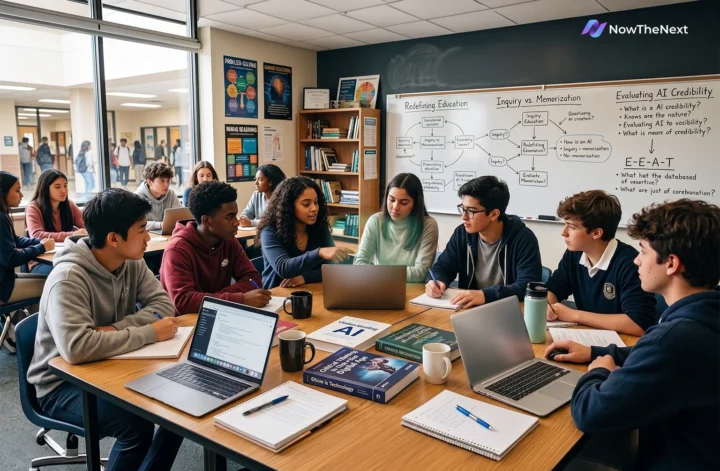
In practice, AI is already being used across the learning cycle. Students use it to brainstorm, summarize, and clarify. Teachers use it to create lesson plans, draft rubrics, simplify difficult ideas, and save time on repetitive work. The technology has arrived not as a single software deployment, but as a new default layer in the knowledge environment.
Why banning AI in education is not the solution
The instinct to ban AI is understandable. If students can use a tool to generate assignments, schools worry about plagiarism, shortcut learning, and a decline in original thinking. But bans often treat AI as a passing disruption rather than as part of a permanent shift in how knowledge is accessed and produced.
A ban may delay the conversation, but it does not solve the problem. Students still encounter AI outside school. Universities and employers are already experimenting with AI-assisted workflows. The result is a mismatch: schools may prohibit the tools students will later be expected to understand and use responsibly.
Moving from memorization to critical analysis
When information was scarce, memorization had obvious value. When information is abundant and instantly retrievable, the premium shifts. The most valuable student is no longer the one who can recall the most facts in isolation. It is the one who can question, evaluate, connect, and apply.
This does not mean memory becomes irrelevant. Foundational knowledge still matters because critical thinking requires material to think with. But the center of gravity changes. Education must now reward interpretation over repetition, and reasoning over recitation.
The evolving role of teachers: from lecturers to guides
Teachers are not becoming less important because AI exists. They are becoming more important in a different way. If a chatbot can provide information, then the teacher’s distinctive value lies in mentorship, interpretation, emotional intelligence, classroom judgment, and the ability to connect knowledge to lived reality.
In the strongest AI-era classrooms, teachers will curate better questions, orchestrate debate, help students challenge assumptions, and teach discernment. They will also model the responsible use of AI: where it helps, where it fails, and where human judgment must override machine fluency.
Redesigning student assessments for deeper engagement
Assessment is where the AI challenge becomes most visible. Traditional homework formats such as generic essays, chapter summaries, or short-answer responses can now be completed with varying levels of AI assistance. The question is not whether this can happen. It can. The question is whether our assessments still measure what we think they measure.
The answer increasingly points toward authenticity. Project-based learning, oral defense, live problem-solving, iterative drafts, peer critique, and applied tasks can reveal much more about a student’s thinking process than outputs alone.
Democratizing knowledge through AI tools
It would be incomplete to describe AI only as a threat. For many learners, AI can lower barriers that previously limited participation. It can explain complex concepts in simpler language, offer multiple ways of understanding an idea, provide instant feedback, and support students who may not have access to tutoring outside school hours.
Used well, AI can make learning more interactive, adaptive, and exploratory. A student can test different framings of the same question, compare explanations, role-play a historical debate, or receive guided support in drafting and refining a response. In that sense, AI can broaden access to intellectual support.
But access without guidance is not enough. Democratization works only when students are taught how to evaluate what they receive. Otherwise, AI can widen confusion as easily as it widens access.
What the classroom after ChatGPT may actually look like
The future classroom is unlikely to be defined by one policy or one tool. It will be defined by a new educational balance. Students will still need foundational knowledge. Teachers will still need strong subject expertise. Schools will still need structure and standards. But the purpose of those systems will shift.
The classroom of the AI era will be less about delivering information and more about cultivating interpretation. Less about reproducing answers and more about examining them. Less about pretending AI does not exist and more about teaching students how to work alongside it without surrendering their own thinking.
In a world where machines can generate text endlessly, education becomes more human, not less. Its task is no longer simply to transfer knowledge. It is to develop discernment, creativity, judgment, and responsibility.
FAQs
AI is best understood as a structural shift, not a temporary threat. The real challenge is not whether schools can keep AI out, but whether they can redesign learning for a world where AI is already part of how people access and produce knowledge.
Teachers are moving from being the sole source of information to becoming guides, interpreters, and mentors. Their role increasingly involves helping students question, verify, contextualize, and think critically about both human and machine-generated material.
Because information retrieval is now inexpensive and instantaneous. Schools still need foundational knowledge, but the highest-value outcomes now lie in analysis, source evaluation, reasoning, and ethical judgment.
Assessment should move toward project-based learning, oral defense, applied problem-solving, annotated drafts, and real-world tasks. These formats make it easier to measure originality, understanding, and the thinking process behind the final output.
Sources used for the statistics and framing
Selected reporting, surveys, and guidance documents used in this article.
- Reuters — ChatGPT sets record for fastest-growing user base
- Gallup / Walton Family Foundation — Gen Z Research
- Gallup / Walton Family Foundation — Three in 10 Teachers Use AI Weekly, Saving Six Weeks a Year
- UNESCO — Less than 10% of schools and universities have formal guidance on AI
- UNESCO — Guidance for generative AI in education and research
- Walton Family Foundation — Understanding Teacher and Student Views on ChatGPT
- Walton Family Foundation — The Value of AI in Today’s Classrooms