
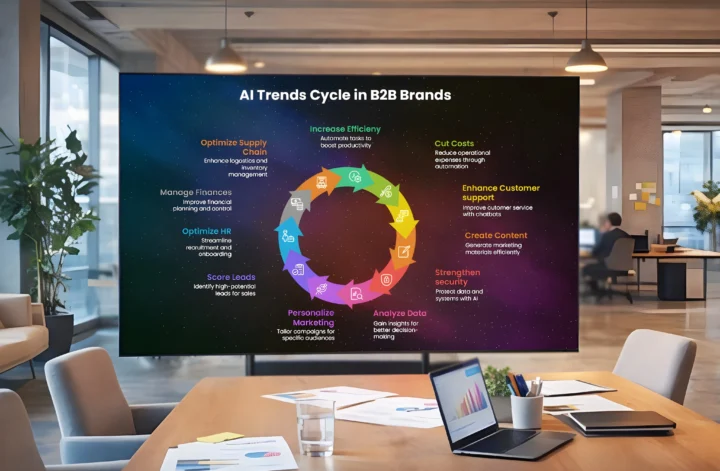
Today, AI has penetrated every sector ,from education and healthcare to global business; becoming an inseparable part of our daily lives as our dependency grows. What once served as a strategic Point of Difference (POD) has evolved into a Point of Parity (POP); transitioning from a competitive edge into a fundamental tool for survival.Today, around 78% of B2B businesses worldwide use AI across at least one business function.
The most common application for AI in today’s organizations is its deployment for increasing efficiency and cutting costs by automating customer support services (chatbots), content creation, security, and analytics. The key use cases of AI are marketing (personalized campaigns), sales (lead scoring), HR (recruitment/onboarding), financial management, and supply chain optimization.
What and how did AI impact B2B Business?
2026 marks the shift of businesses from experimenting with AI in short, isolated functions to large open everyday business operations. If we look at the core business pillars, we will realise that AI has revolutionised how things work in business.
What Makes B2B Different in 2026?
B2B is not the same as B2C, and the way AI is being used here is quite different. In B2B, you are not selling to one person – you are selling to a committee. A typical B2B deal involves multiple stakeholders across finance, IT, and leadership, all with different priorities. AI has made it possible to personalise communication for each of them simultaneously, which was simply not feasible before.
Another big shift is in how B2B buyers behave today. Research shows that B2B buyers now complete nearly 70–80% of their research before they ever speak to a sales representative. This means that by the time your sales team gets on a call, the buyer has already formed an opinion. AI helps businesses show up at the right place, with the right message, much earlier in that journey – through smarter content, intent-based targeting, and Account-Based Marketing (ABM).
The B2B buying cycle is also longer and more complex than B2C. AI is actively helping to compress this by identifying high-intent accounts early, automating follow-ups, and keeping prospects engaged throughout a long decision process. In fact, the average B2B buying cycle has already shortened from 11.3 months to 10.1 months in a single year, largely driven by AI-assisted research and engagement tools. For B2B brands, this is not a small thing – a shorter cycle directly means faster revenue.
Impact of AI on B2B Buying Cycle
Marketing and Sales
AI in marketing has enabled content creation, personalisation, improved metrics and higher productivity. Instead of manual trial and error, B2B business managers now use AI actively to understand what will work on whom. AI helps to create content easily with high scope of personalisation for all prospective clients. While giving more weightage to qualitative metrics like resonance and influence, it has reduced dependence on quantitative metrics like impressions and clicks which has helped to boost productivity.
Core Marketing Advantages:
- Predictive Strategy: Replacing manual trial and error with active AI analysis to understand audience behavior.
- Scalable Personalisation: Creating high-scope personalized content for all prospective clients with ease.
- Value-Based Tracking: Shifting weightage to qualitative metrics like resonance and influence.
- Efficiency Gains: Reducing dependence on quantitative metrics (impressions/clicks) to boost overall productivity.
Reports say that 96% of B2B marketers today use AI in their roles (Demand Gen Report, 2026), which has led around 67% to save more than 10 hours a week for content creation, optimisation, and targeting.
AI in sales enables faster & precise lead management and reduces the sales cycle, thereby improving revenue. It helps to identify which lead might convert and by when it can be converted. It gives predictions and suggestions on how to efficiently convert/manage leads. Businesses thereby have access to more prospective leads and clients.
Key Sales Impacts:
- Accelerated Lead Management: Enabling faster and more precise handling of the sales pipeline.
- Conversion Intelligence: Identifying high-probability leads and predicting specific conversion timelines.
- Optimized Workflows: Utilizing AI-driven predictions and suggestions to manage leads efficiently.
- Market Expansion: Increasing direct access to a wider pool of prospective leads and clients.
Reports say that AI enablement in sales has led to 50% higher win rates, 30% shorter sales cycles, and 13–15% revenue growth on average (InsightMark Research, 2026).
Finance
Finance forms the backbone of a business. Proper management of finance is important as it helps you to achieve long term sustainable competitive advantage. Traditionally, financial management has been time-consuming, complex and prone to mistakes. AI in 2026 helps businesses to make financial decisions by reducing time and by generating accurate and faster financial analysis. It helps to control costs, identify growth drivers and forecast risk and profitability.
The Strategic Role of AI in Financial Management
- Accelerated Decision-Making: AI processes complex data sets in real-time, significantly reducing the time required to make critical financial choices.
- Precision Analysis: Automation removes the risk of traditional manual errors, ensuring high-accuracy financial reporting.
- Cost & Growth Optimization: Intelligent algorithms identify hidden cost-saving opportunities and pinpoint specific drivers for business expansion.
- Predictive Risk Assessment: AI models forecast potential profitability and market risks before they impact the bottom line.
Reports from top firms like Deloitte, McKinsey and Fortune show that AI-mature organisations are achieving 26–31% cost savings in finance & accounting functions, with visionary adopters seeing up to 1.7x revenue growth compared to non-adopters.
Key Financial Performance Benchmarks (2026)
- Cost Reduction: Achieve an average of 26–31% savings within core accounting and finance functions.
- Revenue Multiplier: Visionary AI adopters experience up to 1.7x faster revenue growth than traditional firms.
- Operational Agility: AI-mature organizations transition from reactive accounting to proactive, data-driven financial strategy.
The Financial ROI of AI: In the 2026 landscape, AI-driven financial maturity is no longer an option—it is the primary differentiator, delivering nearly double the revenue growth for businesses that prioritize automated analysis.
Operations
Operations management is critical for analyzing present situations and forecasting future business requirements. Traditionally time-consuming and costly, AI enablement has transformed this function to effectively cut costs, reduce complexity, and streamline processes. It helps in inventory management, supply chain management and assessing risks and opportunities. Today AI acts like a pillar in operations management and is used at all stages from procurement to distribution, inventory management to warehousing etc.
- Process Streamlining: AI reduces operational complexity and automates manual, time-consuming tasks.
- End-to-End Visibility: Integration of AI from procurement and warehousing to final distribution.
- Supply Chain Resilience: Enhanced inventory management and real-time assessment of business risks.
- Predictive Operations: Using historical data to forecast future business requirements with high precision.
According to reports, AI has brought down decision-making time from days to mere minutes. 87% of enterprises now use AI for demand forecasting, driving a 35%+ improvement in accuracy, and companies with mature AI supply chain systems report 25–30% higher operational efficiency than their peers (IBM & Deloitte, 2025). ROI of AI implementation in operations has been ~190% on average.
Proven Financial Impact: Delivering an average ROI of ~190% on AI implementation within operations.
Rapid Decision-Making: Transformation of operational timelines from days to minutes.
Accuracy in Forecasting: A 35%+ increase in the accuracy of demand forecasting models.
Competitive Efficiency: Achieving 25–30% higher operational efficiency compared to traditional systems.
Human Resource Management
Human Resource Management comprises of recruitment, employee wellbeing and organisational structure and policies. Traditionally, it has been complex and time-consuming. With introduction of AI, businesses reduce hiring time and costs through AI resume screening and interview scheduling. It also helps to manage employees efficiently by enabling chatbots, employee feedback and personalised learning paths. It also helps to implement and update organisational policies and procedures.
Core Benefits of AI in Modern HRM
- Accelerated Recruitment: Reduces hiring cycles through automated resume screening and intelligent interview scheduling.
- Employee-Centric Management: Enhances the workplace experience via AI-driven chatbots and real-time feedback loops.
- Tailored Professional Growth: Leverages personalized learning paths to close skill gaps and improve retention.
- Dynamic Policy Integration: Simplifies the implementation and updates of complex organizational procedures.
Reports from SHRM and Gartner mention that AI implementation has led to 31% faster hiring times, 33% reduction in cost-per-hire, and an average ROI of 340% within 18 months of adopting AI recruiting tools – with 62% of employers expecting to use AI for most hiring steps by 2026.
The 2026 Efficiency Outlook: With a projected 340% ROI and a shift toward 62% of employers automating hiring processes, AI is no longer optional for HRM—it is the primary driver of competitive organizational health.
Conclusion
If there’s one thing 2026 has made clear, it’s that AI in B2B is not a trend anymore ; it’s just how business gets done now. The companies winning today are not necessarily the biggest or the oldest, they are the ones who figured out how to use AI well and early. Whether it’s getting a competitive advantage or simply saving your team hours doing repetitive work , the impact is real and it is increasing over time. Businesses that are still observing are not just missing out; they are actively falling behind.
FAQs
No, AI enables small businesses to work as efficiently as large businesses.
Generally, sales and marketing function sees the fastest and most visible results.
AI is not replacing rather it’s reshaping how organizations utilize the human resource.
Businesses that have implemented AI in focused areas like recruiting or sales have reported significant growth within the first 12–18 months.
Glossary
Parity
The state of being equal.
Stakeholder
A person with an interest or concern in something, especially a business.
Feasible
Possible to do.
Prospect
The possibility that something will happen.
Prospective
Likely to be or to happen; possible.
Resonance
The quality of being deep, clear and continuing for a long time.