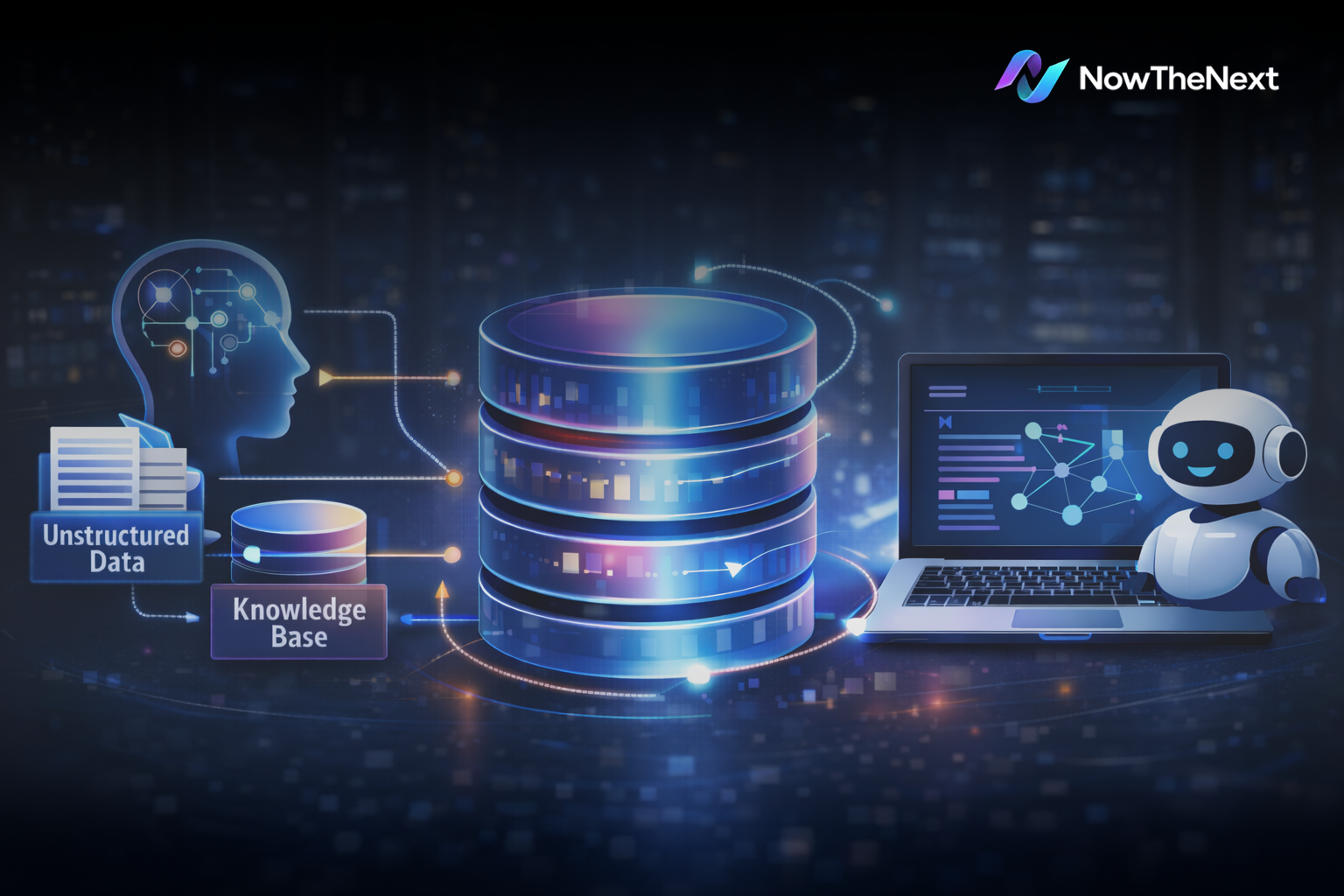
Most enterprises today want their AI systems to work on internal knowledge. Policies. Product documentation. Customer conversations. Project notes. The assumption is simple. Give AI access to your data, and you’ll get smarter outputs.
But this is where things start to feel off.
Even with Retrieval-Augmented Generation (RAG) in place, many teams still find that answers feel incomplete. The AI knows the documents exist, but it doesn’t always surface the right ones at the right time. What you get is something that looks impressive in a demo, but feels unreliable once people actually try to use it.
The problem isn’t RAG itself. It’s what sits underneath it.
Enterprise data was never designed to be searched the way AI needs to search. Traditional databases are great at finding exact matches. AI needs to find meaning. And until that gap is addressed, most RAG implementations will struggle to move from something that works occasionally to something teams can actually depend on.
What RAG Actually Is (And Why It Exists in the First Place)
RAG is moving quickly from experimentation to real investment. The market was valued at about USD 1.2 billion in 2024 and is projected to grow to nearly USD 11 billion by 2030, which shows just how fast enterprises are betting on retrieval-driven AI systems.
RAG is often explained in technical terms. In practice, it exists because AI doesn’t actually know your business. If you want useful answers from internal data, you first have to help the model find the right context to work with.
Why large language models struggle with enterprise data
Large language models are trained primarily on publicly available data. They’re good at language, not at knowing your policies, internal docs, or customer conversations. When you ask something specific to your organisation, the model only knows what you pass into the prompt.
This is where things usually break down. Even when teams connect AI to their data, retrieval is often weaker than they realise. The model sees only a few snippets. If that context is incomplete, the answer still sounds confident, but it isn’t grounded in what your organisation actually knows.
How RAG changes how AI answers questions
Retrieval-Augmented Generation changes the flow by putting context first. The system pulls relevant information from your data before the model responds.
When this works well, answers feel more specific and relevant. The model stops guessing and starts responding based on your actual knowledge.
Why Traditional Databases Break Down for AI Search
A recent research overview found that approximately 80.5% of current RAG implementations rely on standard retrieval frameworks such as FAISS or Elasticsearch for search and ranking, indicating how common retrieval layers are in real-world projects today. Most enterprise data lives in systems built for very specific questions. If you know exactly what you’re looking for, they work well. The problem is, people don’t usually search that way. And AI doesn’t either.
Keyword search falls apart when questions aren’t exact matches
Traditional search depends on exact wording. You type a phrase, the system looks for those same words. In real work, queries are rarely that precise. People use shorthand. They phrase things differently from how they’re written in docs.
So you might search for “contract renewal policy,” while the document says “agreement extension process.” To a keyword system, those are different things. The information exists, but it doesn’t surface. When retrieval fails like this, the AI on top can’t help much. If it doesn’t see the right context, it can’t give a useful answer. Retrieval quality quietly becomes the limit on output quality.
Enterprise databases weren’t built to understand meaning
Most enterprise systems were designed for transactions and reporting. Tables and schemas work well for that. They weren’t built to recognise that two different phrases can mean the same thing.
AI relies on this kind of semantic understanding. Without it, useful knowledge stays hidden behind rigid structures. The data is there, but the system can’t surface it in a way that matches how people actually ask questions.
What a Vector Database Actually Does (In Simple Terms)
The global vector database market is expected to grow from about USD 2.65 billion in 2025 to nearly USD 8.95 billion by 2030, exhibiting a strong compound annual growth rate (CAGR) of ~27.5 %.
USD MN
People often describe vector databases as “AI databases,” which sounds fancy but doesn’t really tell you much. The simpler way to think about them is this. They help systems search by meaning, not just by matching words. That one shift changes how useful your data becomes for AI.
How embeddings turn text into something machines can work with
Computers don’t understand language the way people do. They work with numbers. Embeddings are how we translate text into numbers that roughly capture what the text is about.
So instead of treating two sentences as completely different just because the wording is different, embeddings place similar ideas closer together. For example, “how do I reset my password” and “trouble logging into my account” don’t share many words, but they mean something very similar. With embeddings, the system can recognise that similarity.
Why vector search works better for messy enterprise knowledge
Enterprise data is rarely neat. It lives in PDFs, emails, internal docs, support tickets, and wikis. Different teams describe the same thing in different ways. Keyword search struggles here because it expects consistency in language.
Vector search is more forgiving. It can surface relevant content even when the wording doesn’t line up neatly. It helps connect questions to answers buried deep inside long documents. And most importantly, it lets AI retrieve context that actually matches what you’re trying to ask, not just the words you happened to type.
Why RAG Without a Vector Database Fails at Scale
RAG often looks impressive in early demos. You connect a basic search layer to a language model, and suddenly, your AI can answer questions from your documents. It feels like progress. Then the system meets real enterprise data, and things start to feel less reliable.
Why early RAG pilots feel promising but degrade quickly
Early pilots work with small, tidy datasets. There’s less variation in how information is written, fewer duplicates, and fewer edge cases. Basic retrieval seems “good enough.” As data grows, it breaks down. Keyword search starts missing relevant context or pulling in loosely related content.
At the same time, performance issues creep in. More data means slower retrieval and higher costs. What felt fast and simple in a demo begins to feel clunky in real usage.
What breaks when retrieval quality drops
Up to 80 % of enterprise data is unstructured (like documents, emails, PDFs), which traditional databases can’t easily search, making semantic retrieval approaches like vector databases vital for AI usefulness. When retrieval weakens, answers become generic. The model doesn’t have strong context to work with, so it fills in gaps. Hallucinations increase. Over time, trust drops. People stop relying on the system for real work and treat it as something to double-check.
What Changes When You Pair RAG with a Vector Database
The difference between an AI demo and an AI system people actually use usually comes down to retrieval quality.
Better retrieval leads to better answers
Vector search retrieves context based on meaning, not just wording. This gives the model better input, leading to more specific, grounded answers. Hallucinations drop because the model isn’t forced to guess as often.
Why this changes adoption inside enterprises
Once answers start feeling reliable, behaviour changes. Teams begin to trust the system. It moves from being a demo tool to something people use in real workflows. That’s when AI stops feeling experimental and starts feeling useful.
What Enterprises Need to Think About Before Implementing RAG
RAG is not a feature you switch on. It changes how your data layer, security model, and AI workflows are designed. A few things matter more than teams usually expect.
Data readiness and quality still matter
- The answers will be messy if the data is messy.
- Before retrieval works successfully, unstructured content needs to be cleaned up a bit.
- Documents that are the same or out of date make retrieval harder.
- Versioning is important so that AI can get the proper, up-to-date information.
- The freshness of answers is what keeps them relevant.
Security, access control, and governance
- Retrieval should follow role-based access constraints.
- Sensitive information must not get out to other user groups
- You should be able to trace AI responses back to the papers they came from.
- Logging is important for audits and following the rules.
- Before scale, there needs to be governance, not after.
Conclusion
RAG isn’t just about making AI sound smarter. It’s about making sure your AI is working with the right information in the first place. When retrieval is weak, even the best models produce shallow or unreliable answers. That’s why vector databases aren’t a nice-to-have layer. They’re foundational to how RAG works at scale.
For enterprise leaders, this is a system design choice, not a tooling experiment. The organisations that get this right will move faster from pilots to real adoption, because their AI systems will be built on data they can actually trust.
FAQs:
Most traditional databases are built to find exact matches and structured queries. RAG works best when the system can find information by meaning, not merely by keywords. Without that, the AI often doesn’t have enough or good context.
RAG gives AI responses a basis by using context from your data. The model makes fewer guesses and gives more accurate, useful responses when it has the correct information in front of it.
RAG helps AI use your data to answer questions. It doesn’t only use what it learnt during training; it first gets relevant information from your systems and then uses that knowledge to come up with an answer.
No. Vector databases are best for AI that needs to work with unstructured data, like emails, papers, or knowledge bases. If your queries are simple and structured, traditional databases can be all you need.
NowTheNext Glossary
RAG (Retrieval-Augmented Generation)
A method where AI retrieves relevant information from your data before generating a response.
Embeddings
Numerical representations of text that capture meaning and allow similarity-based search.
Vector Database
A database optimized to store and search embeddings by meaning rather than keywords.
Semantic Search
Search that understands intent and context instead of exact keyword matching.
Hallucination (AI)
When an AI model generates incorrect answers that sound confident but are not factual.