We are finally trading the AI that says “I’m sorry, I don’t understand” for the AI that simply says “Consider it done.”
Agentic AI is an advanced form of artificial intelligence focused on autonomous decision-making and action. Unlike traditional AI that primarily responds to prompts or analyzes data, agentic AI can take a goal, plan a sequence of steps, and execute those tasks across tools and systems with minimal human intervention.
Before you decide how fast to move on to agentic AI, answer one question honestly.
Would you trust AI with a task, not just a prompt?
If your answer is even a hesitant “yes,” that is exactly why 2026 matters to you as a leader. It’s not just another year of experimenting with GenAI. It’s already a thing of the past now. It is the year more organizations start running on AI agents. It completes tasks end-to-end within your existing workflows and business tools, with a measurable Return on Investment (ROI).
“Harmony Direct 2.0 is built to deliver operational intelligence and system efficiency, helping operators scale more confidently.”
Anshuman Divyanshu, CEO, EVSE Business, Exicom
You need systems that not only analyze problems but also solve them. Agentic systems are where this bottleneck finally starts to break.
Going forward into the article, you might come around terms like agentic systems, agentic AI, AI agents, goal-driven AI, proactive AI, multi-agent systems, or compound AI systems. They all point to the same shift that AI does things, not just says things.
To really appreciate how big that shift is, let’s take a step back and see where it came from.
Agentic AI evolved from 1940s feedback loops to 2026’s billion-dollar reality
The story of agentic AI is not a sudden leap. It is a long build-up of ideas about control, cognition, and proactive behavior. These ideas are combined with modern computing and data.
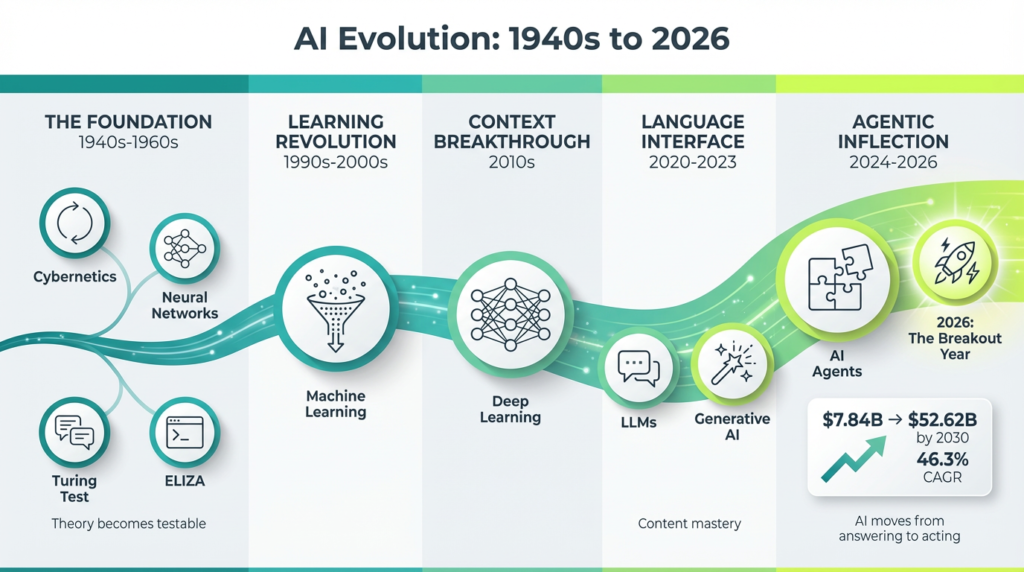
Feedback loops, computational system, turing test, and multi-agent behavior laid the foundation
The origin starts with something as simple as feedback loops.
Your office thermostat senses the temperature, compares it to a target, and turns the heat on or off. That repeating loop of sensing and acting is the basic pattern behind agent-like behavior. In the 1940s, Cybernetics by Norbert Wiener popularized this way of thinking about systems that perceive, process information, and adjust automatically.
Then followed the push to model intelligence itself. In 1943, Warren S. McCulloch and Walter Pitts published “A Logical Calculus of the Ideas Immanent in Nervous Activity.” It helped frame the brain as a computational system and influenced neural network thinking.
Later on, in 1950, Alan Turing’s “Computing Machinery and Intelligence,” published in Mind, proposed what later came to be known as the Turing Test. It was developed as a method to assess machine intelligence via dialouge.
Don’t you find it striking that this development in 1950 matters enormously now for you as a leader? Because once something can be evaluated against clear criteria, it can be systematically improved over time.
Soon after, in 1959, Oliver Selfridge’s “Pandemonium” model introduced the idea of many small specialist “demons” operating in parallel, each responsible for a narrow signal or feature. The overall “intelligence” emerged from how these demons competed and cooperated to influence the final decision.
If modern multi-agent systems feel intuitive today, it is largely because they build on this same core principle of distributed, interacting agents.
Did You Know?
In 1966, decades before today’s AI boom, MIT computer scientist Joseph Weizenbaum built one of the first chatbots and called it ELIZA. The name came from Eliza Doolittle, the Cockney flower girl in George Bernard Shaw’s Pygmalion (and My Fair Lady), who is trained to sound like high society without truly belonging to it. Weizenbaum chose the name deliberately. Like the character, ELIZA learned to mimic sophisticated conversation through clever pattern matching, yet it showed how easily conversation can feel intelligent, even without real reasoning or task execution.
Evolution from the 1990s till now
From that foundation, AI stopped being mostly theory and started getting practical.
Machine learning in the 1990s and 2000s shifted AI from hand-coded rules to learning patterns from data.
Deep learning advances in the 2010s improved context handling and adaptation.
Large Language Models (LLMs) in the early 2020s made natural language interfaces dramatically more capable.
And then, in 2024 and 2025, agents combined LLMs with tools and retrieval patterns such as Retrieval-Augmented Generation (RAG). This made multi-step task execution more realistic.
If that sounds like the direction we have been heading for years, you’re right.
The next question is what pushed agents from “possible” to “inevitable.” That is where today’s key milestones come in.
OpenAI, Google, Meta, and Interface.ai are shaping Agentic AI today
If you want to understand how real this shift is, just follow the money. Google, Meta, Microsoft, Amazon, and OpenAI are racing to build systems that autonomously pursue goals rather than wait for prompts. OpenAI’s project “Strawberry” signals their push into sustained reasoning and complex tool use.
Amazon’s licensing deal with Adept shows this has moved from research to commercial reality. As Cisco’s VentureBeat AI Impact Tour declared, agentic AI represents “the next giant leap forward.”
What does this look like in practice?
Interface.ai’s financial services agents already handle workflows requiring multiple specialists.
- Their fraud detection systems monitor patterns continuously, freeze suspicious accounts automatically, and learn from each incident.
- Virtual financial advisors analyze customer goals in real-time, adjusting investment strategies and identifying opportunities without human direction.
- Loan applications that once took days are now completed in minutes through coordinated agent activity. This agent assesses creditworthiness, recommends products, and guides approvals autonomously.
So if financial services are already automating complex decisions, what does this transformation mean for your industry?
Technologies, business models, and investments are defining the current landscape
6 technologies and enterprise trends creating an agentic AI infrastructure in 2026
By 2026, AI agents are not turning up on their own. They arrive with a whole wave of enterprise trends that make this proactive AI easier to deploy and much harder to ignore.
- Agentic platforms move you beyond chatbots into multi-step execution across tools and third-party services, often with low-code or no-code deployment plus built-in governance.
- Generative Artificial Intelligence (GenAI) copilots continue shifting from pilots to daily operations. International Data Corporation (IDC) predicts copilots will be embedded in 80 % of enterprise workplace applications in 2026.
- Industry Cloud Platforms (ICPs) are becoming the default for regulated, vertical use cases. Gartner predicts 70 % of enterprises will use ICPs by the end of 2026, up from under 15 % in 2023.
- Quantum computing raises two enterprise priorities at once: breakthrough problem-solving in areas like finance and logistics, and the push for quantum-safe encryption planning.
- Zero-trust edge (ZTE) expands as devices and hybrid work grow. With 72 % of organizations adopting or planning zero-trust frameworks, identity and access checks shift closer to where data is created and used.
- Extended reality (XR) moves toward mainstream enterprise adoption, with training and remote assistance use cases. The XR market is projected to reach 380 billion dollars by 2036.
You could also see real-world agentic AI in action via Exicom. They are already deploying the kind of autonomous, intelligent systems that define agentic AI in their EV charging solutions. Their Exicom One platform leverages AI-driven technologies to provide predictive maintenance, smart load management, and automated user experiences through Harmony Connect AI.
Agents are now entering a business setting that is at last prepared for them. The more difficult question is what actually happens inside your business when agents begin doing real work.
Organizational and business model shifts
This is where the shift becomes leadership-level, not just technical.
McKinsey’s “agentic organization” idea is useful because it describes what you can expect to change together: how you deliver value, how work flows, how governance works when non-human actors take action, and how teams collaborate with agents.
MIT’s research adds a simple way to think about business models that emerge from this, ranging from adding AI into existing processes to proxy-style delivery, modular service assembly, and ecosystem orchestration.
The organizational structure transforms alongside these business model shifts. Coordination-heavy middle layers thin out as agents handle routine workflow management. New roles like ‘agent orchestrator’ emerge to manage human-AI interfaces. Meanwhile, IDC warns that 90 percent of enterprises face critical AI skills shortages by 2026, creating a talent gap that could derail even well-funded implementations.
So the question is not just “Should we use agents?” It is “What kind of organization do we become once we do?”
Exicom’s experience deploying AI-driven autonomous systems in EV charging infrastructure offers a practical answer to that question.
“Harmony Direct 2.0 is designed to offer improved control, customization, and confidence in EV infrastructure. This product reflects our understanding of global technology trends and local market needs.”
Anant Nahata, Managing Director and CEO, Exicom
Gartner and IDC projects agentic AI’s market outlook for 2025 to 2026
If you are still deciding whether this is real momentum or just noise, the numbers are pretty clear.
MarketsandMarkets puts the AI agents market at around 7.84 billion dollars in 2025 and 52.62 billion dollars by 2030. This is about 46 % compound annual growth.
Gartner expects 40 % of enterprise applications to have task-specific agents built in by 2026, up from under 5 % in 2025.
IDC projects that by then, 40 % of roles in Global 2000 companies will involve direct engagement with agents, with tools already able to remove more than 40 % of a typical workday.
These figures indicate that agentic AI is not a peripheral trend but rather a core infrastructure, as crucial to 2026 operations as email was to the 2000s.
However, Gartner warns that over 40 percent of agentic AI projects will be canceled by 2027 when organizations fail to define clear value or control escalating costs.
In short, the opportunity is huge, but it is not forgiving. The execution demands precision.
Investment and adoption trends
Want to see what the smartest investors already know?
The capital flows speak for themselves.
Venture funding reached 2.8 billion dollars in the first half of 2025 for agentic AI (AI Agents Directory).
On the adoption side, McKinsey reports that 62 percent of organizations are already engaged with agentic AI, with 23 percent scaling it across the enterprise and 39 percent still experimenting. MIT Sloan Management Review sees a similar trajectory, finding roughly 35 percent adoption within two years and another 44 percent of organizations planning deployment.
Across these studies, the pattern behind both successes and failures is consistent: the model is rarely the main blocker. Results hinge on foundations like data access and permissions, integration into real workflows, security and identity controls, and clear ownership of outcomes.
Which leads to the final, practical question: how do you move forward confidently, without becoming one of the programs that gets cut when the ROI story does not hold up?
The leaders, platforms, and firms turning agentic AI into practice
Thought leaders and influencers are supporting the agentic AI wave
Andrew Ng is strongly advocating for “agentic workflows” as the next step beyond simple chatbots.
On the big-tech side, you can see a clear pattern emerging.
Mustafa Suleyman at Microsoft AI and Demis Hassabis at Google DeepMind are leading the charge to blend generative AI with truly autonomous capabilities, not just smarter chatbots.
Simultaneously, Yann LeCun at Meta often weighs in with candid, technically grounded views on how far agents can and should really go, keeping the conversation honest and anchored in hard science.
Then you have practitioners like Noelle Russell, Seth Earley, and Allie K. Miller. They focus less on theory and more on helping enterprises actually deploy these systems in production environments.
Leading companies and platforms are forming an agentic ecosystem
On the platform side, a clear pattern is emerging.
Microsoft, OpenAI, Google DeepMind, NVIDIA, and Anthropic provide the core intelligence and infrastructure that make agentic behavior possible. Around them, a fast-growing ecosystem is forming.
UiPath and Automation Anywhere are turning classic tasks automation into agentic workflows. LangChain and similar frameworks give developers the building blocks for multi-agent systems.
Vendors like Moveworks, Adept AI, Cognition AI, and Relevance AI are already shipping agents. These agents handle IT support, navigate software interfaces, or even act as autonomous software engineers.
As Exicom’s experience in EV infrastructure shows, the organizations that win are the ones that treat intelligence as part of the control stack and operations fabric, not as an add‑on tool.
Analyst and research firms
Analyst and consulting firms are not just commenting from the sidelines.
McKinsey, Deloitte, EY, and BCG are helping large enterprises design and scale agentic architectures.
Similarly, firms such as Straive, Aisera, LatentView, and Tellius are proving that agents can cut research and analysis cycles from weeks to minutes. It can be done by letting AI handle the heavy lifting across huge, messy datasets.
2026 will be the year to shift to autonomous AI
2026 is the year AI starts doing tasks because all the pieces finally line up at once: mature models, agentic platforms, enterprise-ready infrastructure, and clear proof that agents can safely execute end‑to‑end work with measurable ROI.
Organizations like Exicom are already letting intelligent systems manage load, diagnose issues, and keep networks running at scale. It is exactly what enterprises will now expect across their digital workflows.
The leaders who treat 2026 as the year to operationalize agents, not just experiment with them, will set the competitive baseline everyone else spends the next decade trying to match.
Frequently Asked Question
It is a setup where multiple AI agents collaborate or delegate tasks, often using specialized roles, to complete larger workflows.
It is a method where a model retrieves relevant information before generating an answer. It can improve accuracy when agents need grounded, enterprise-specific knowledge.
It is a cloud platform tailored to an industry with pre-built data models and compliance configurations. Gartner predicts 70% of enterprises will use ICPs by the end of 2026, up from under 15% in 2023.